On January 11, 2009, a man in California wrote two words on the internet: “Running bitcoin”. No full stop, no explanation, no thread afterwards. It was a status message about a program that was running on his computer right then.
Today the sentence is one of the most quoted in Bitcoin's history. What few people know: for the man who wrote it, it came true a second time that same year, in a way he could not have guessed back then. And it took on a third meaning only after his death.
He died on August 28, 2014. This is the longest text we have ever written, and the only one where we did not care about the length. Anyone who knows Hal Finney only as a footnote in Bitcoin's history knows the smaller half.
Who was Hal Finney?
Harold Thomas Finney II, born on May 4, 1956 in Coalinga, California, was a cryptographer long before Bitcoin existed. He studied at the California Institute of Technology, earned his first money programming console games. Then he landed in the field that would define his life.
He worked with Phil Zimmermann on PGP, the encryption that made e-mail tap-proof for ordinary people for the first time and that the US government considered so dangerous in the early nineties that it investigated Zimmermann for three years. When the project turned into a company, Finney was, in his own words, “one of the first hires”. He stayed there until his retirement in early 2011.
Alongside that he wrote on the Cypherpunk mailing list, that circle of programmers, mathematicians and activists who in the nineties held one simple thesis: privacy in a digital world does not come from laws, it comes from code. Finney ran one of the world's first anonymous remailers, a tool that let messages travel the net anonymously, twenty years before anonymity on the internet became a mass topic. He built the things other people were still discussing.
In 2004 he came closest to the goal: RPOW, Reusable Proof of Work, a digital means of payment whose units were based on proofs of work and could be passed on. It worked. It just still needed a single server as its linchpin. Exactly that one gap stayed open.
Four years later somebody else closed it. And Finney saw immediately what he had in front of him.
January 11, 2009: two words
On January 3, 2009 the genesis block came into being. A few days later Satoshi Nakamoto released the first version of the software. “When Satoshi announced the first release of the software, I grabbed it right away”, Finney wrote later. He started it and posted the sentence that would outlive him. In his Californian local time it was still January 10; to this day the Running Bitcoin Challenge starts on that day too.
What “running bitcoin” meant technically back then: the client of 2009 was a single program: node, wallet and mining in one. Whoever started it ran a full node: it held the entire block chain, checked every transaction and passed it on. Whoever also switched on “Generate Coins” under Options was mining right along. Finney did both.
Nothing ceremonial was meant by it. The software was running on his computer, and back then almost nobody else was doing that. “I think I was the first person besides Satoshi to run bitcoin”, he wrote later, carefully phrased. That caution was justified: analyses of early log files suggest that in the first days one or two more machines were running along. That does not change the order of magnitude. Back then you could count the network on one hand. To many, that makes him the first Bitcoiner.
“I mined block 70-something”, he wrote about those first days. Difficulty was at 1 back then, an ordinary processor was enough for a block. He stopped because the machine ran hot and the fan noise bothered him. “In retrospect, I wish I had kept it up longer”, he wrote in 2013, “but on the other hand I was extraordinarily lucky to be there at the beginning.” It is worth picturing for a moment: the Bitcoin network consisted of a handful of computers, and one of them was switched off because it was too loud.
The first Bitcoin transfer: Block 170
On January 12, 2009, one day after the tweet, Satoshi Nakamoto sent him ten Bitcoin. As a test. It was the first Bitcoin transaction between two people, recorded in Block 170, still readable in the blockchain today, with the same proof as on the day it was written.
In the days that followed Finney exchanged e-mails with Satoshi, reported bugs, made suggestions. He was not just one of the first users. He was the first person who took the thing seriously.
The second “Running”: 2009 was his running year too
Here comes the part that is missing from most texts about Hal Finney.
When he wrote “Running bitcoin”, he was himself in the best physical shape of his life. In his own words: “I was in the best shape of my life at the start of that year, I'd lost a lot of weight and taken up distance running. I'd run several half marathons, and I was starting to train for a full marathon.” A lot of weight lost, several half marathons in his legs, the first marathon training begun. In May 2009 he ran the Los Angeles Marathon, as a benchmark for Santa Barbara in December, where he wanted to improve on that time. The goal behind it: a Boston qualifying time.
Running was no side matter for him. He planned some of his runs a month ahead and ran on business trips too. The half marathon was his distance. Fran ran as well.
So in the same year in which the network started running, Hal Finney was running himself. And in the same year he stopped.
August 2009: the diagnosis
“My body began to fail me”, he wrote. Slurred speech, less strength in his hands, legs that would not recover any more. In August 2009 he got the diagnosis: ALS, amyotrophic lateral sclerosis. A disease that destroys exactly those nerve cells that control the muscles. First the legs, then the arms, then speech, at the end breathing. The mind stays clear. You watch yourself go.
Eight months earlier he had been training for a marathon.
17 days later: 1:59:27
And then something happens that we consider the strongest moment in this whole story.
Seventeen days after the diagnosis, Hal Finney ran a half marathon.
On September 6, 2009 he went to the start line in Anaheim, together with Fran. It was not a race any more. They ran together, he stayed with her, had to pause often and was sore for a long time afterwards. They crossed the line hand in hand, arms up. 1:59:27. Under two hours, seventeen days after a doctor had told him that his nerve cells were dying.
It was his last real race.
A few weeks before that, after a run of eighteen kilometers, he had written online that he had come to appreciate every single run far more. A small, quiet sentence. You only understand it once you put the date next to it.
December 2009: the last two miles
On December 6, 2009 the Santa Barbara International Marathon took place, the revival of a race that Santa Barbara had last seen in 1984. It was exactly the race Hal Finney had long had firmly in his plans. By race day he could no longer run and was walking with a cane.
He went anyway. The fundraiser had been Fran's idea: the Muscular Dystrophy Association put the Finneys into the race as part of a relay team, and the money went to ALS research. Fran was to run the last leg and hand him the timing chip. Hal covered the last two miles on foot, Fran at his side, surrounded by family, friends and the other team members in yellow T-shirts.
Not being able to run was no reason for him not to reach the finish. He only changed the method. A year later he was there again. That time he crossed the finish line in a wheelchair he steered himself.
The man who foresaw the second layer
A year later, on December 30, 2010, Finney wrote something in a forum post that today reads like a weather forecast made in 2010 for the weather of 2026:
“Bitcoin itself cannot scale to have every single financial transaction in the world be broadcast to everyone and included in the block chain. There needs to be a secondary level of payment systems which is lighter weight and more efficient. […] I believe this will be the ultimate fate of Bitcoin, to be the 'high-powered money' that serves as a reserve currency for banks that issue their own digital cash.”
In plain words: Bitcoin on its own cannot carry every payment in the world. It needs a second, lighter layer on top. And in the end Bitcoin will be the hard money underneath, the layer everything else is built on.
He wrote that a good four years before the first Lightning whitepaper and more than seven years before the network actually ran. Anyone sending sats over Lightning today is using exactly the layer Finney described back then, without being able to build it.
“Bitcoin and me”, the text from 2013
On March 19, 2013 Finney published a post in the BitcoinTalk forum titled “Bitcoin and me”. In it he wrote about the early days, about Satoshi, about RPOW, about his illness. It is one of the few documents in which a Bitcoin pioneer speaks about himself.
The most sober sentence in it is the heaviest: “Today, I am essentially paralyzed. I am fed through a tube, and my breathing is assisted through another tube. I operate the computer using a commercial eyetracker system.”
What comes after it is remarkable. He kept programming. Not until his hands failed, but beyond that: with his eyes, by his own estimate around fifty times slower than before, on software for storing Bitcoin safely. On the side he built himself an interface with a microcontroller that let him steer his wheelchair with his eyes.
Fifty times slower. Most people stop at ten percent headwind. He carried on at two percent speed.
His conclusion falls almost in passing in that text: “All in all, I have had a good life.” And the last sentence reads: “I'm comfortable with my legacy.”
What he was put through on top of it
There is a part of this story that is rarely told, because it is ugly.
Finney was one of the few early developers whose real name was known. That made him vulnerable. In the last year of his life the family was blackmailed: an anonymous caller demanded 1,000 bitcoin, over 400,000 dollars at the time. In May 2014 the police were suddenly outside the house, a helicopter circling above it: a faked emergency call. In the two months that followed, the caller phoned nine more times and threatened the family. Hal was lying in bed paralyzed at that point.
And one more thing belongs to the truth, because the opposite is stubbornly repeated: Hal Finney did not die a Bitcoin millionaire. As the treatment costs rose, he sold most of the coins he had mined early, at a price of around 100 dollars. Fran on that, matter-of-factly: it was fine if it meant that Hal could stay at home and be well.
The man who received the first Bitcoin transfer in history spent his coins on care. Anyone who takes “Diamond Hands” for a character trait should know that.
August 28, 2014
On August 28, 2014 at 8:50 a.m. Hal Finney was pronounced dead in Scottsdale, Arizona. He was 58 years old.
The network kept running. In its whole history it has had two serious incidents: a bug in 2010 that briefly created billions of bitcoin out of nothing, and a split of the chain after a software update in 2013. Both fell within Finney's lifetime, both were contained within hours. Since then it has run without a comparable incident, including on the day one of its first operators died. That is exactly the thought that carries on this date: Bitcoin is built so that it needs nobody. Not him either.
We remember him anyway. Not out of nostalgia, but because otherwise the early years shrink into an anecdote. Bitcoin was built by people who risked something at a time when there was neither money nor recognition in it.
The man who bet on the longest horizon
There is a footnote to Hal Finney's story that says a lot about him. He had arranged his cryonic preservation more than twenty years before his death. Immediately after he was pronounced dead, the Alcor Life Extension Foundation took him into their care. He is their 128th patient there, listed under the number A-1436. He paid for it with a life insurance policy and with bitcoin donated to him by people who knew his work.
You do not have to consider that realistic. But you should see the conviction behind it. All his life Finney bet on things whose return lay far in the future: encryption, when hardly anyone needed it. Digital money, when there was none. A second payment layer, when there was barely a first one. And in the end on a medicine that does not exist yet.
Anyone who wants to know what Low Time Preference means taken to its conclusion, namely doing something today whose benefit only arrives much later, will find in Hal Finney the most complete example that Bitcoin's history has to offer.
Was Hal Finney Satoshi Nakamoto?
The question has kept coming up for years, and you understand why. Four things come together:
- He was a cryptographer and had been part of the Cypherpunk movement since the nineties, exactly the milieu that Bitcoin came out of.
- With RPOW he had built the closest predecessor four years earlier. Nobody else was that close to the idea.
- He was one of the very first to start the software, and the first recipient of a transaction.
- And the most curious footnote: for years he lived a few kilometers away from a man called Dorian Satoshi Nakamoto, the man a US magazine wrongly presented as the real Satoshi in 2014.
You can build a theory out of that. It is not proven. Finney denied being Satoshi during his lifetime, and none of the later style and message analyses could show it. To this day the question is unsettled, and it probably never will be settled.
Something else interests us at this point: it makes no difference. What is proven is that he was the first recipient of a Bitcoin transaction, one of the first miners, an early bug finder and for years one of the clearest minds around the project. You do not have to make him Satoshi to find his role big. Anyone who does makes the story smaller, not bigger, and then it is about a mystery instead of about a person.
Bitcoin does not care whether he was Satoshi, and neither do we. He believed in Bitcoin when the network consisted of a handful of computers and nobody out there knew the name. To us he is a hero and one of the strongest personalities Bitcoin has ever had. He stands for everything Bitcoin is about and everything that made this community strong.
He does not need that title. He has one of his own:
Hal Finney – First runner. First believer. Forever a legend.
What became of the two words
After Finney's death the sentence could have stayed a quotation. It did not.
Since January 2022 there has been the Running Bitcoin Challenge, led by Fran Finney and hosted by the ALS Network. The classic distance is the half marathon, Hal's favorite distance. Shorter routes work too, walking or rolling. Whoever takes part collects donations for ALS research, paid in Bitcoin. The fifth edition ran from January 10 to 31, 2026. According to Fran Finney, runners from over 50 countries have started in his name since then.
A status message turned into an annual movement that raises money against exactly the disease its author died of. That is, if you like, the most honest form of Proof of Work: you claim nothing, you do it.
The third meaning: one more step
“Running bitcoin” now has three meanings, and the third is the reason we are writing this text at all.
First, literally: a node is running at your place. You verify for yourself instead of trusting. That is the technical meaning, and it is the only one Finney meant.
Second, physically: you look after the body you are going to live in for the next few decades. Whether you still climb stairs at eighty is decided at forty. Low Time Preference does not stop at the savings plan.
Third, and this is the core: Hal Finney kept going to the very end. He took one more step. And then another. First jogging. Then on a cane. Then with his eyes.
Our head usually sets the limits earlier than the body would. Anyone who really believes that something is possible releases energy that was not there before. That holds for the savings plan just as much as for the last five kilometers, and just as much for the thing you have been putting off for two years.
The principle behind it is unspectacular: what you do every day is what you are. Not what you resolve once in January. The small repetitions add up like compound interest: quietly, invisibly, and then visible all at once. It is the same mechanism that turns 25 euros a month over ten years into something you can no longer argue away. Start small, but start. And then take one more step.
That is why the sentence is on a running shirt with us and not on a coffee mug.
Wearing the sentence

Because this story matters to us, it is on two shirts here, not as decoration, but as a quotation with an origin.
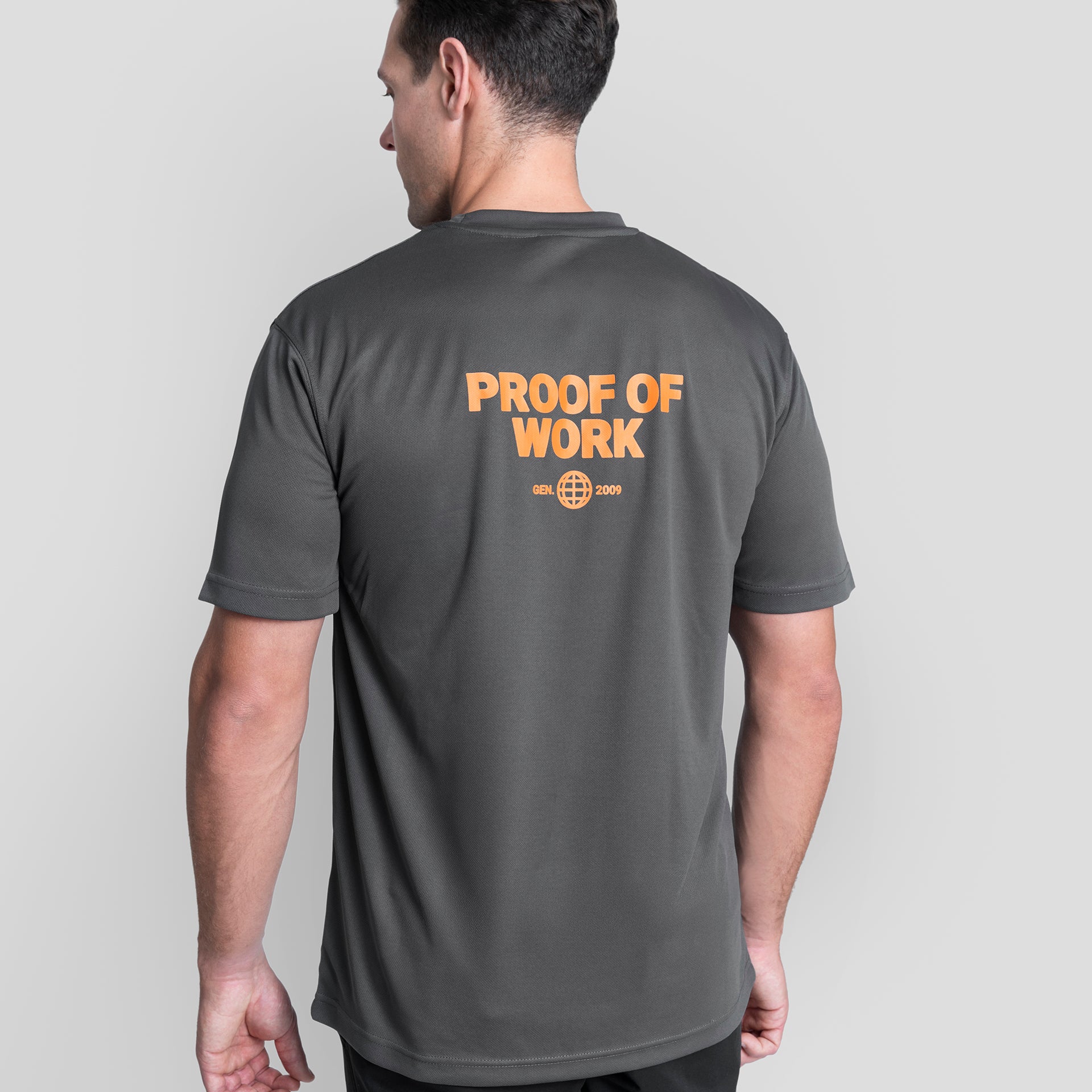
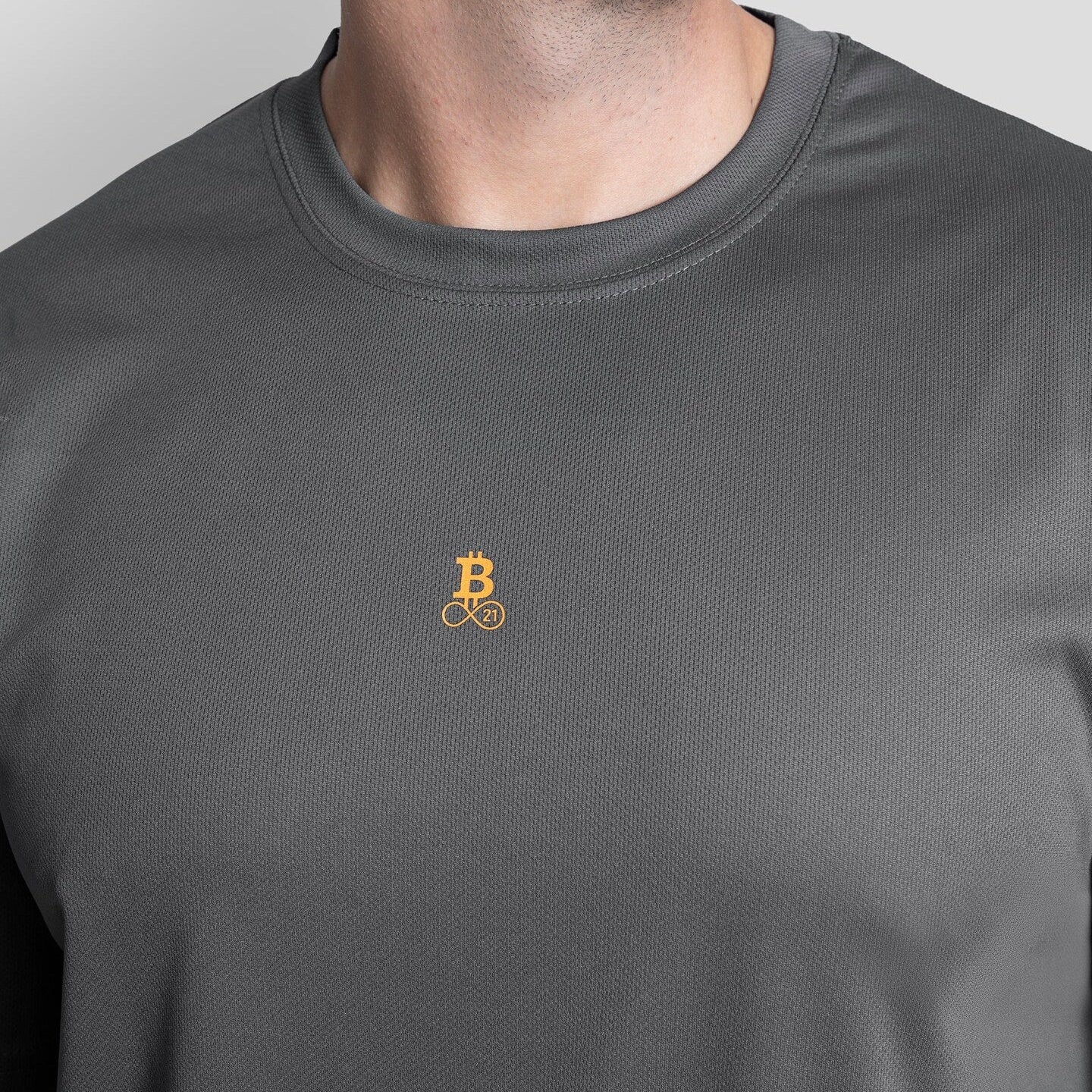
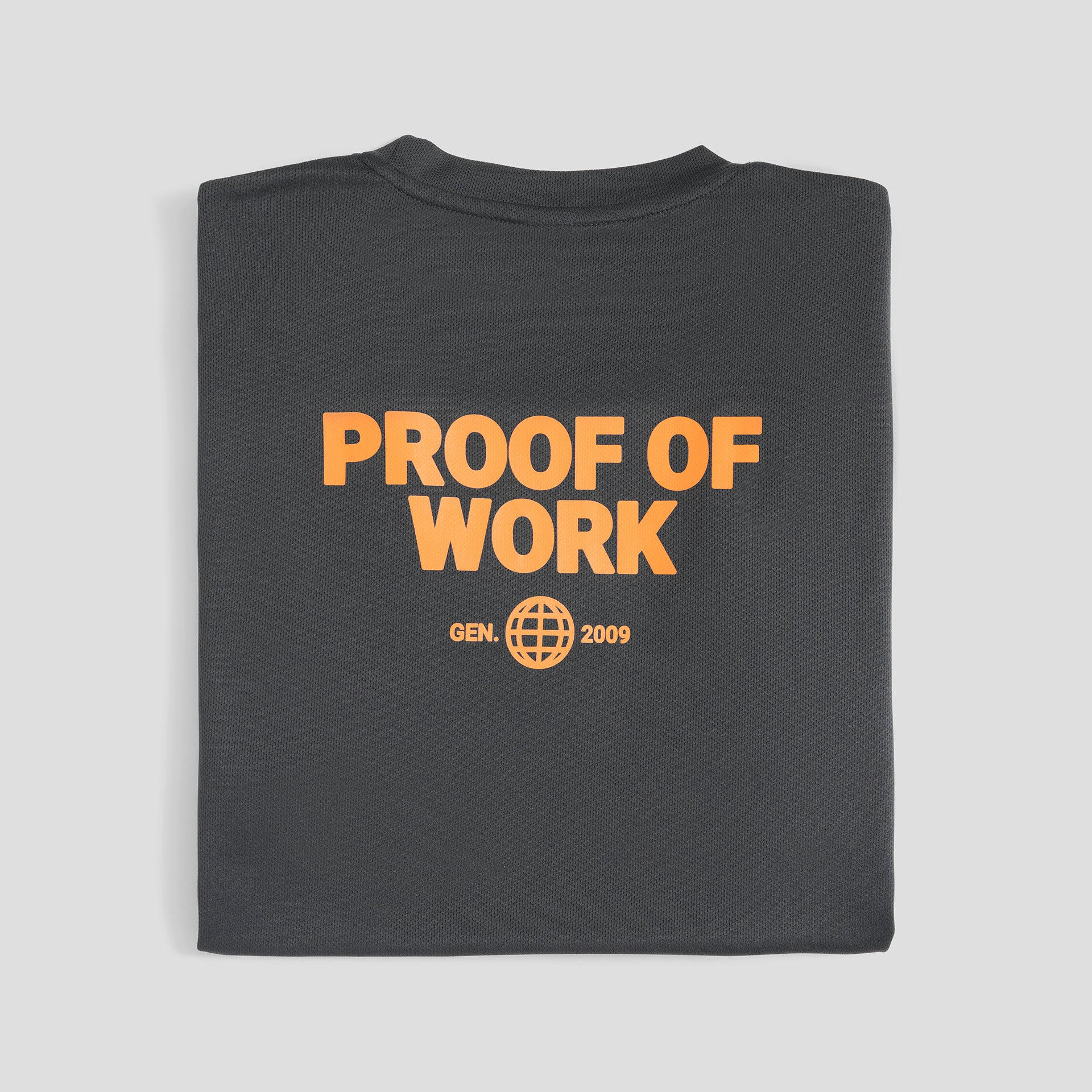
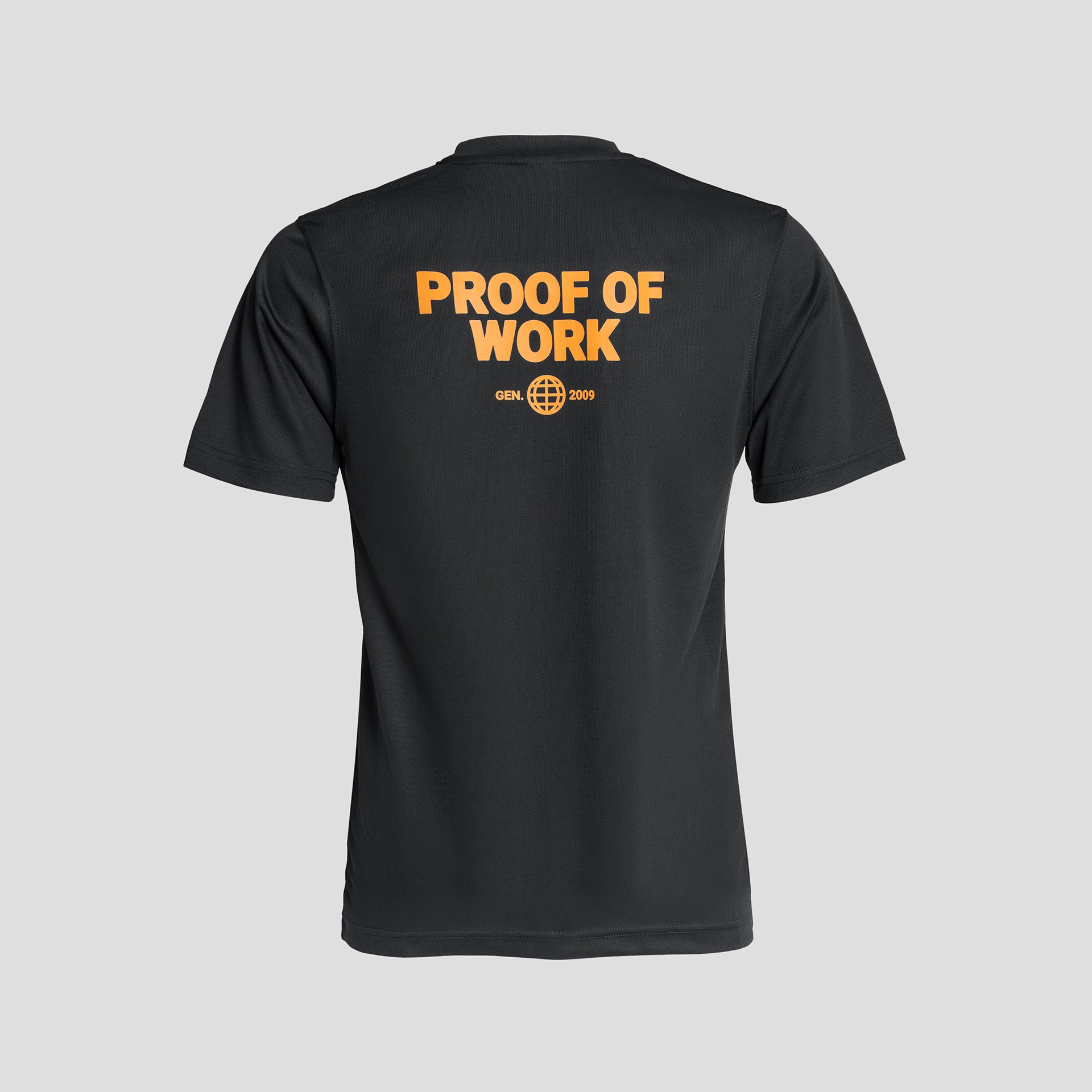
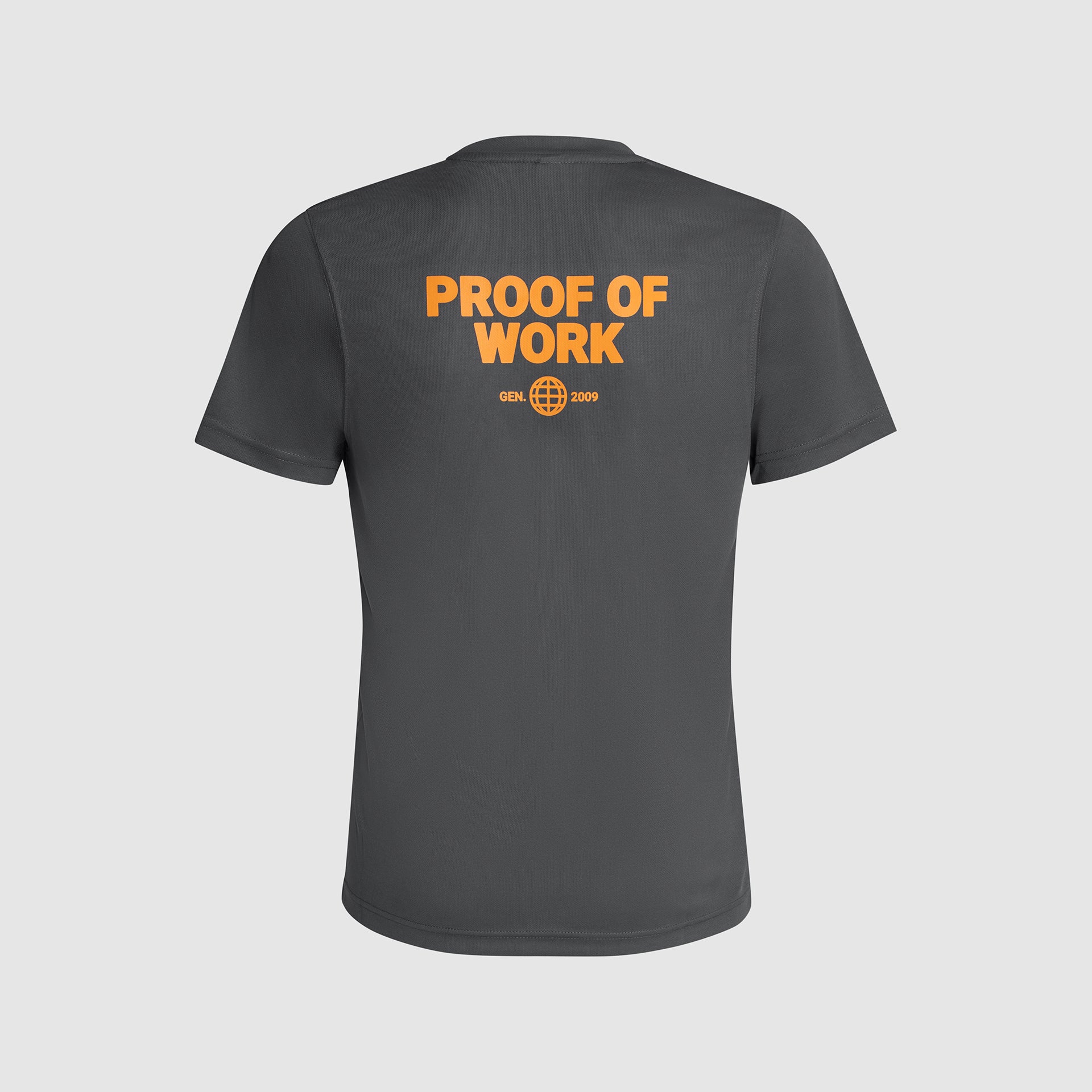
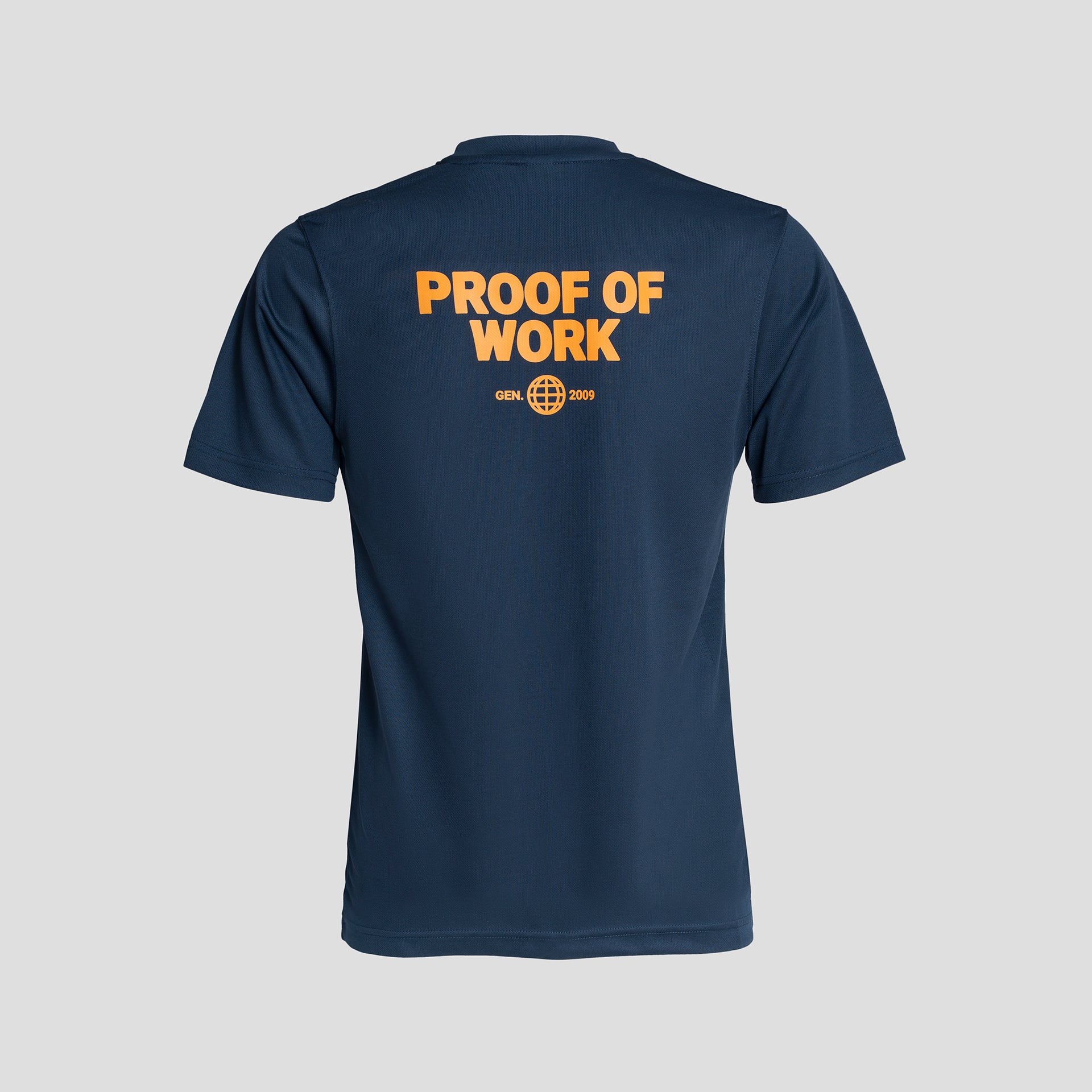
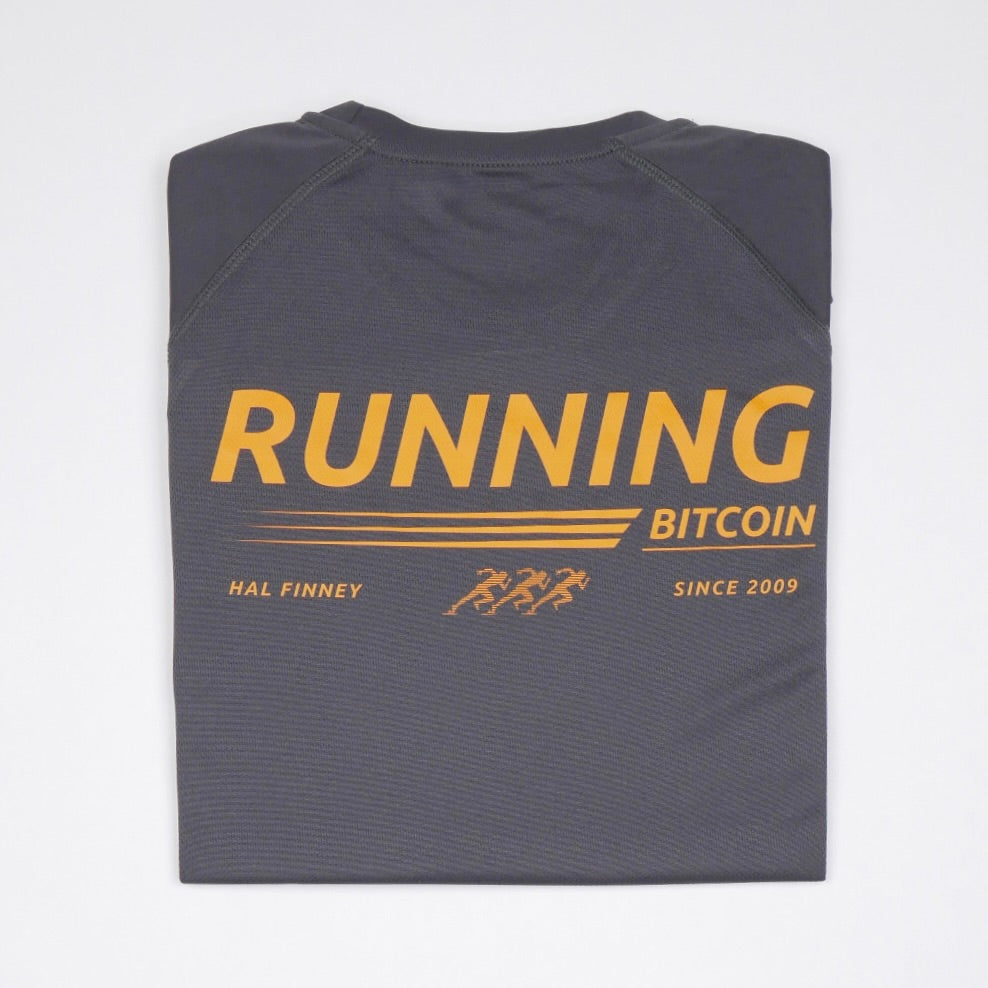
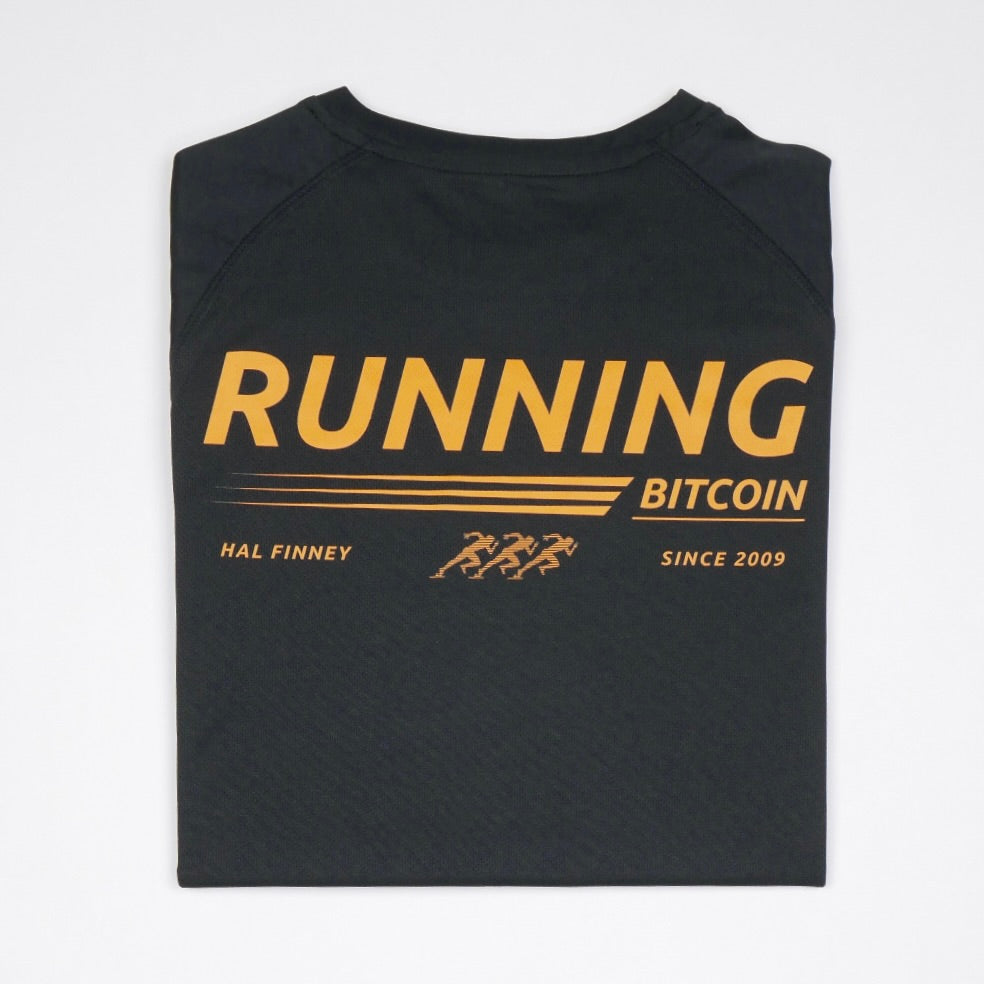
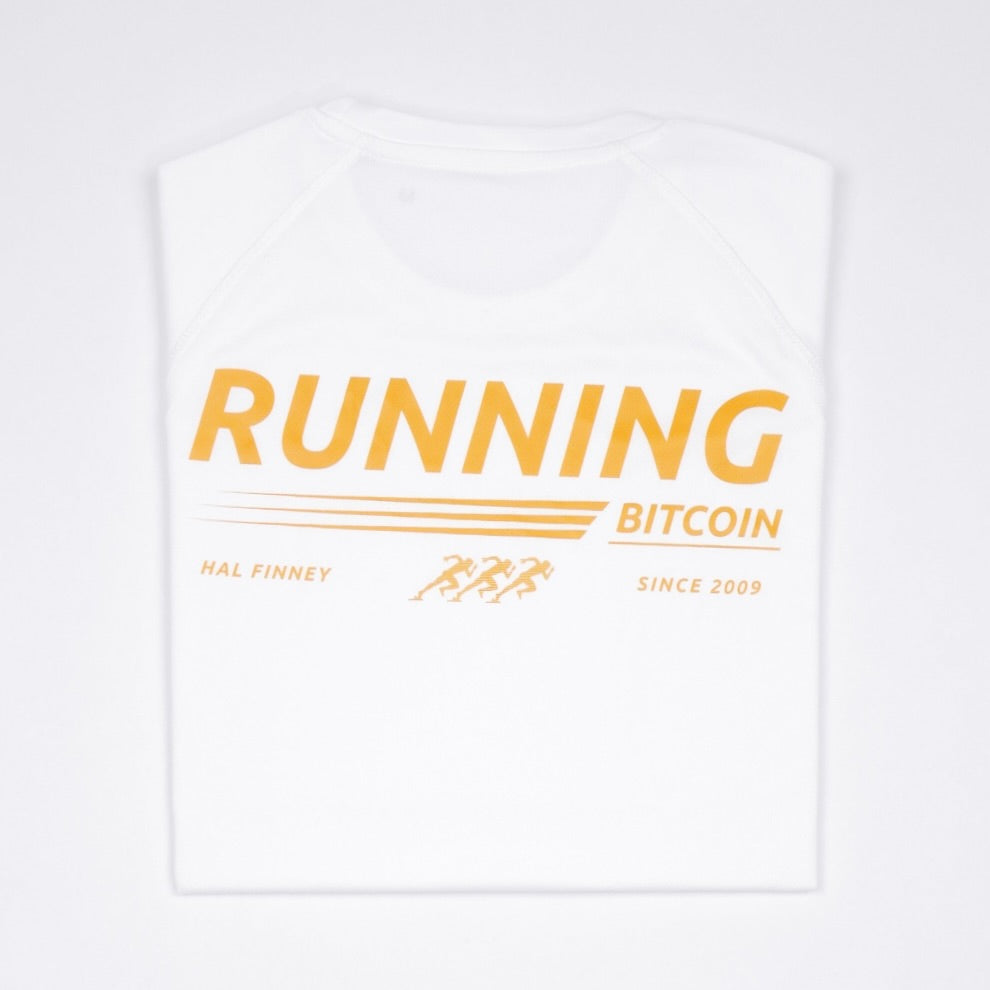
The Bitcoin Running Shirt Running Bitcoin carries the two words typographically on the back, quiet and clear. The Bitcoin Running Shirt Hal Finney shows them as a large motif with a runner, plus the year 2009 and his name, the second meaning, made visible.
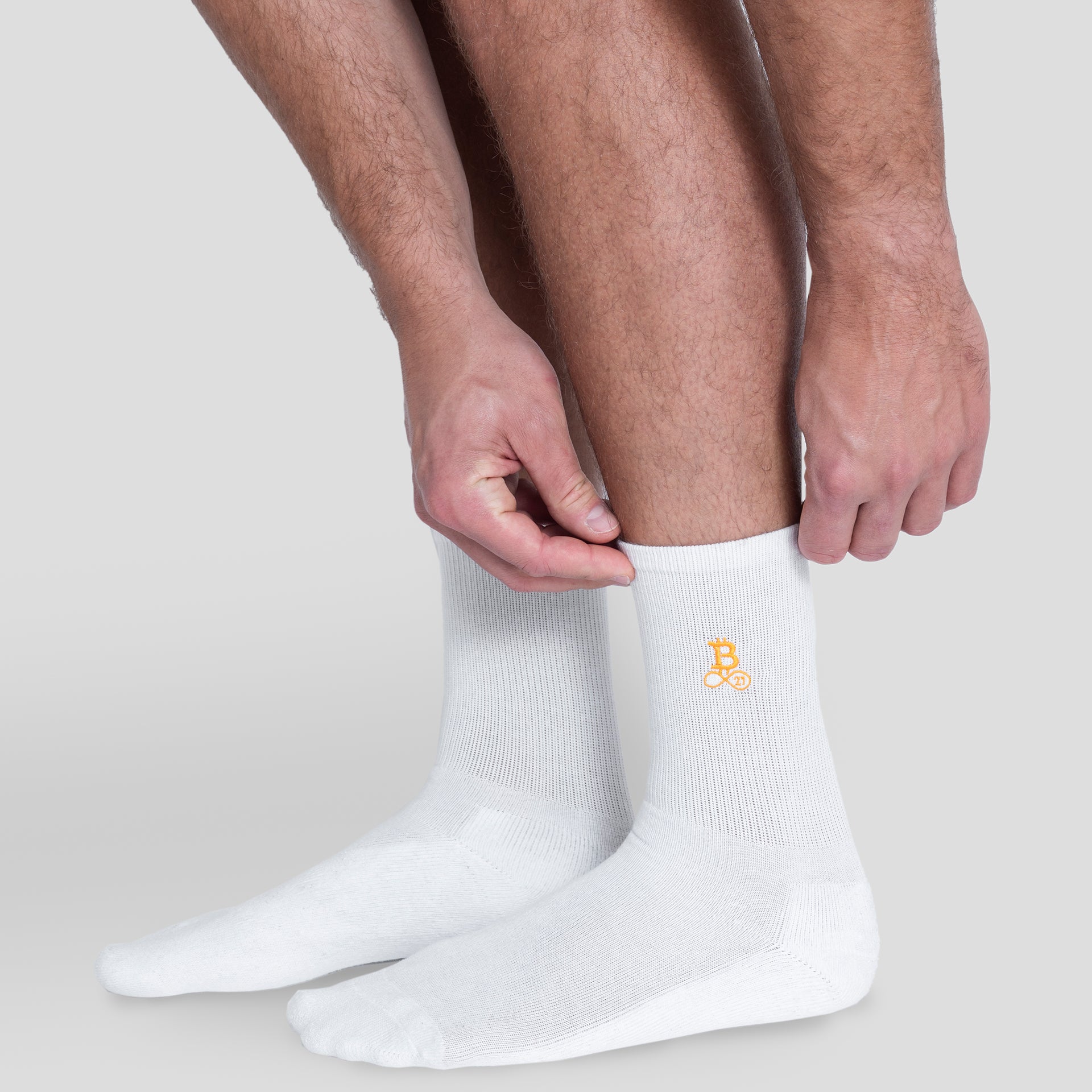
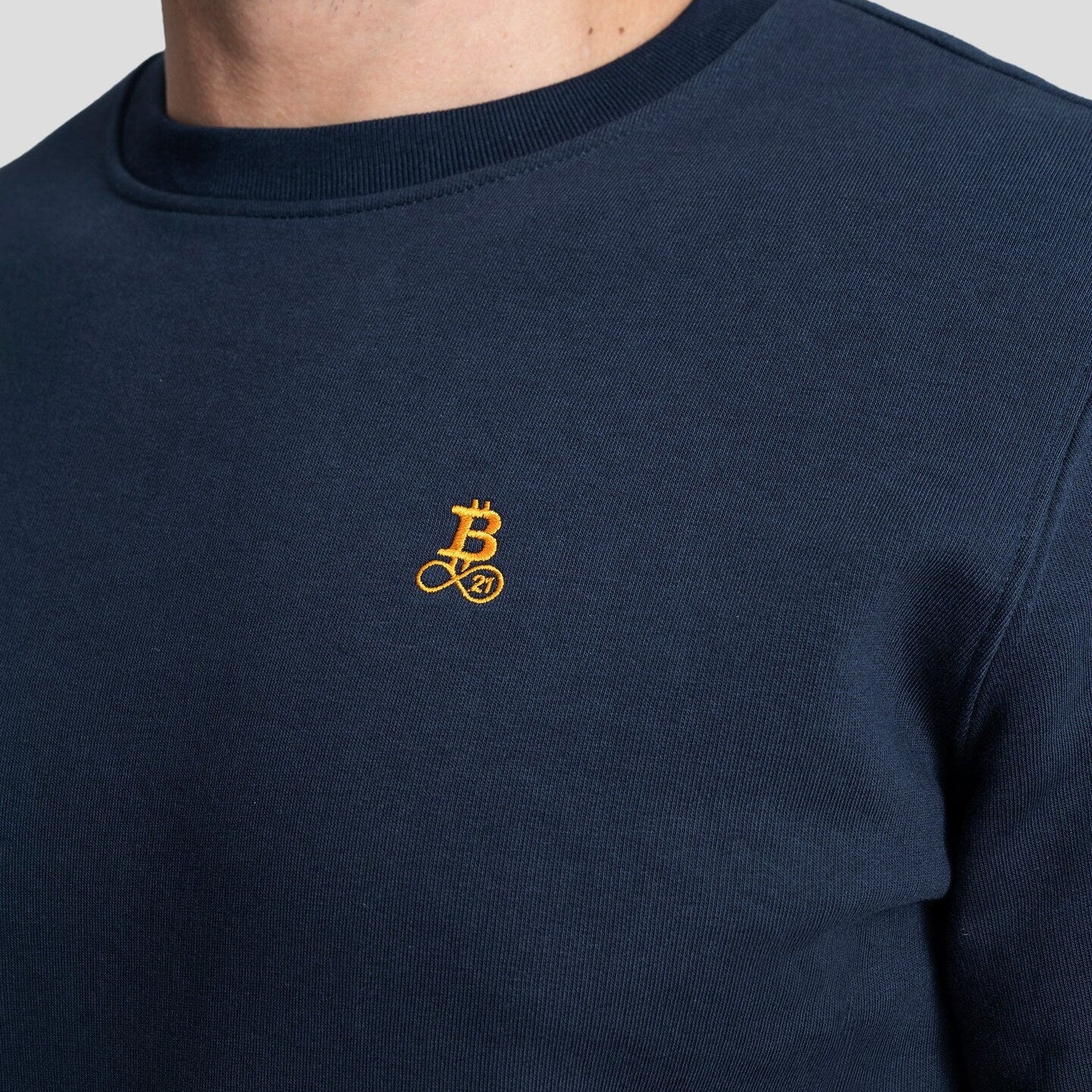
Both are the same light performance shirt: 135 g/m² of 100% polyester, moisture-wicking, with mesh ventilation and UV protection 40+, in Black, Charcoal and White from S to XXL. Made for running. What else, with a sentence like that. You will find everything else in our Bitcoin sportswear.
And if you run the Running Bitcoin Challenge in January: you now know why it is called that.
Frequently asked questions about Hal Finney and “Running Bitcoin”
What does “Running Bitcoin” mean?
The sentence comes from Hal Finney, who published it on January 11, 2009. It meant that the Bitcoin software was running on his computer. He was one of the very first to start it at all. Because Finney was a runner himself, the sentence has taken on a second meaning that he never intended.
Who was Hal Finney?
A US-American cryptographer (May 4, 1956 – August 28, 2014). He worked on the encryption software PGP, developed the predecessor system RPOW in 2004 and, by his own account, was the first person besides Satoshi Nakamoto to run the Bitcoin software.
When was the first Bitcoin transaction?
On January 12, 2009. Satoshi Nakamoto sent Hal Finney ten Bitcoin as a test. The transfer is recorded in Block 170 of the blockchain.
Was Hal Finney Satoshi Nakamoto?
It is suspected, but it is not proven, and Finney denied it during his lifetime. The points in favor of the theory are his Cypherpunk past, his predecessor system RPOW, his role in the first days and the fact that he lived only a few kilometers away from Dorian Satoshi Nakamoto. None of that is proof. What is proven is that he was the first recipient of a Bitcoin transaction, mined early on and corresponded with Satoshi by e-mail in the first days.
What did Hal Finney die of?
Of ALS (amyotrophic lateral sclerosis). He got the diagnosis in August 2009 and died on August 28, 2014 at the age of 58 in Scottsdale, Arizona.
When was Hal Finney's last race?
On September 6, 2009 he ran a half marathon in Anaheim together with his wife Fran and finished in 1:59:27, seventeen days after his ALS diagnosis. On December 6, 2009 he still took part in the Santa Barbara International Marathon, but as part of a relay team: he could no longer run by then, and he walked the last two miles with a cane.
Did Hal Finney keep his Bitcoin?
No, not all of them. As the costs of his treatment rose, he sold most of the coins he had mined early at a price of around 100 US dollars. The rest, by his own account, was in a safe deposit box and was meant for his children.
What is the Running Bitcoin Challenge?
An annual running event in January that has existed since 2022. It is led by Fran Finney, the widow of Hal Finney, and hosted by the ALS Network. Participants run a half marathon or a shorter distance and collect donations for ALS research, paid in Bitcoin. The fifth edition ran in January 2026.
What happened to Hal Finney after his death?
He had arranged his cryonic preservation more than twenty years earlier. Directly after he was pronounced dead, the Alcor Life Extension Foundation took him into their care, where he is kept as their 128th patient under the number A-1436.
The network has not skipped a day since his death, and the two words are still there.
Take one more step.
Keep stacking sats,
Tobi & Henry